
Proximity to Magnificent Power
Reflection on Audience with Pope Leo XIV ahead of his AI encyclical publication.

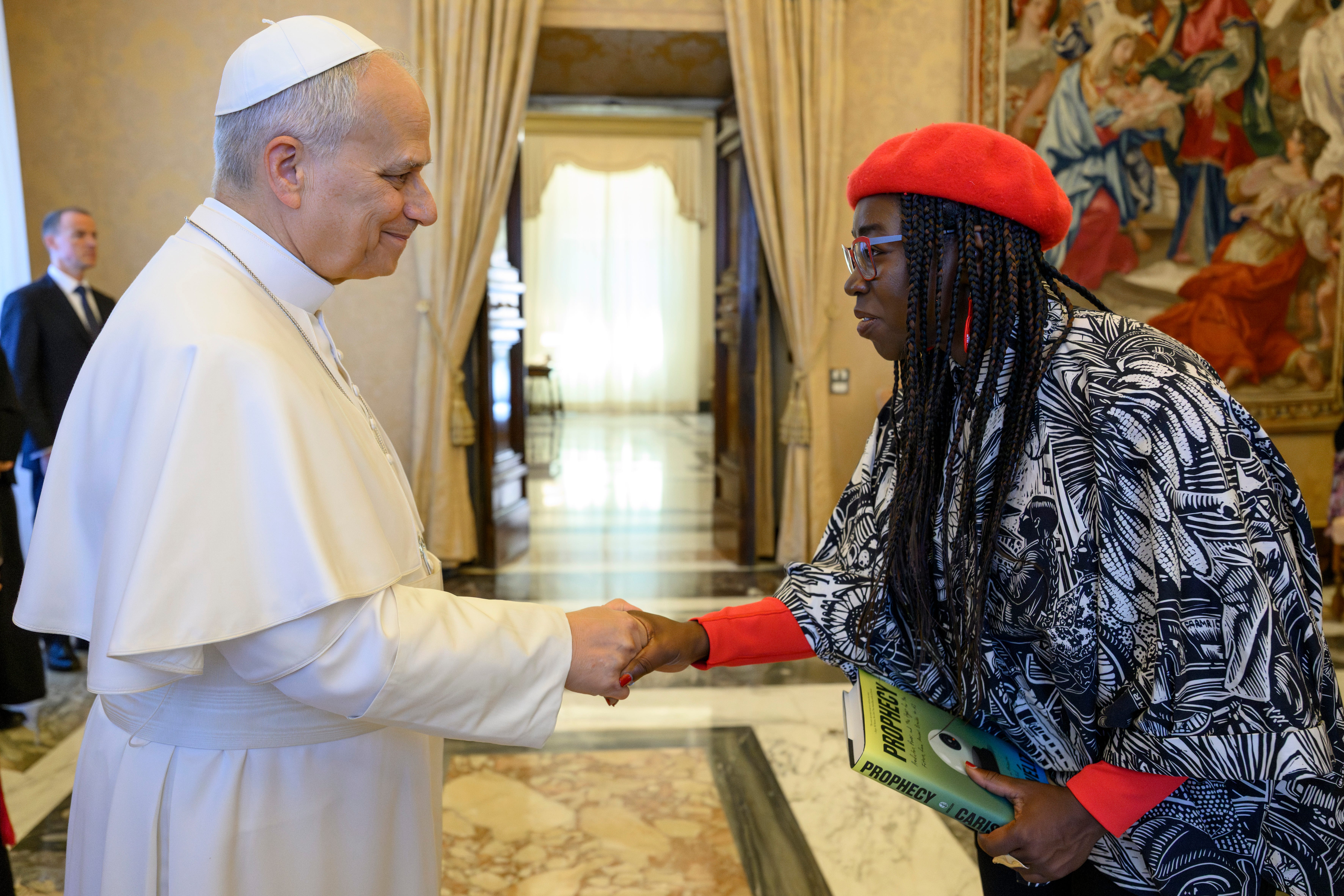
Shaking the hand of Pope Leo XIV and gifting him PROPHECY by Carissa Véliz is more than a moment seared on the shores of my memory.
The exchange occurred days before the release of his historic AI encyclical MAGNIFICA HUMANITAS: On Safeguarding the Human Person in the Time of Artificial Intelligence. In due time, I will share a deeper reflection on what it means in the context of algorithmic justice. Today, I want to talk about proximity to power.
Too often, halls of power lack proximity to the very people they claim to serve like the excoded, those harmed by AI systems, present only in abstraction. Too often, those with proximity to power serve as gatekeepers instead of gate-openers.
The work of The Algorithmic Justice League (AJL) is made possible because so many leaders have opened gates for me. Visionaries dared to believe that narrative power and empirical data turn stories into real-world change. Through AJL and my MIT research, I exposed AI bias in products from leading tech giants and created the language, evidence, and narrative that made it impossible to dismiss. We work on creating a world where no one is excoded. Because of AJL, AI bias is common knowledge now. What remains uncommon is sharing access to power.
Last November, Megan Smith, the former CTO of the USA , invited me as her Vatican guest. As I write in UNMASKING AI she is a gate-opener I have long admired. She used her access to open opportunities for me and many others to engage in critical Vatican conversations about AI. We brought a delegation including Camille François, Executive Director of ROOST.tools which creates open-source AI safety tools to safeguard children interacting with chatbots.
That delegation also included Cathy O'Neil, whose book WEAPONS OF MATH DESTRUCTION inspired me to create an organization focused on preventing AI harm. The destructive path of AI is laid bare in MAGNIFICA HUMANITAS. Without intervention, environments, livelihoods, and human life itself are destroyed by an AI race for supremacy at all costs. One way to reclaim our humanity in a world of accelerated AI adoption is to create shared experiences around goals bigger than any one individual or organization.
On this second visit to the Vatican, I was pleased to be joined by Ayah Bdeir and Nabiha Syed, who through Current AI and the Mozilla Foundation are creating infrastructure for alternative AI futures that respect human dignity and make possible a world where AI works for all of us, not just the privileged few.
To the Dicastery For Communication, thank you for the invitation to speak at the "Preserving Human Voices and Faces" conference and for your generosity of spirit.
What invitations might you extend to others? Whose name can you bring into the halls of power? Whose work can you carry into rooms they may never enter?
----
♻️ Share to encourage someone you know to expand the aperture of participation.
💭 Comment: whose work in AI should we be amplifying?
The phrase 'proximity to magnificent power' cuts right to the core of what's broken in AI governance — access and accountability don't move together. The people closest to these systems are often the last to be consulted when harm occurs. Your work on algorithmic bias remains one of the clearest frameworks for why representation in AI development isn't just an ethics issue, it's a structural governance failure. Following your work closely.
Gate openers. Love this. But also the entire piece inspires.
Thank you, Joy!